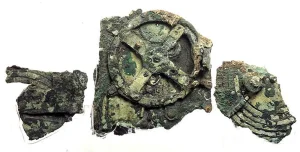
Discovered in 1901 in a Roman-era shipwreck off the coast of Antikythera, Greece, the Antikythera Mechanism is often called the world’s first analog computer. Dated to around 150–100 BCE, this bronze-geared device could predict eclipses, track lunar phases and planetary movements, and even calculate the timing of the ancient Olympic Games. Its mechanical complexity stunned modern scientists, revealing a level of ancient knowledge and engineering thought lost to time.
The story of its discovery is as fascinating as the device itself—sponge divers expecting treasure found a corroded lump that would take over a century to decode. Only with modern imaging and computational techniques did scholars finally unlock its secrets.
Much like AI today, the Mechanism was a leap forward in using machines to predict and model complex systems. Then it was the cosmos; now it’s everything from climate to human behavior. Both reflect a timeless human drive: to understand the world, not just observe it. And like AI, the Mechanism raises profound questions—not just about technology, but about the civilizations that create it, the knowledge we preserve or lose, and the future we shape.